

How to Start a Kids Content Business with AI (No Design Skills, No Freelancers)
You’ve seen it everywhere. Etsy shops earning thousands of dollars a month selling printable coloring pages. YouTube Kids channels with no face, no camera — just illustrated storytelling videos pulling hundreds of thousands of views. Amazon KDP publishers quietly building passive income from children’s books they didn’t illustrate by hand.
Every time you look into how to do it yourself, you hit the same wall: how are these people actually making this content?
You’re not a designer. You’re not an animator. You can’t afford a freelancer for every product, and you’re not about to pay $300 per month for a stack of tools you barely understand.
Here’s the truth — most of those creators aren’t doing it manually either. They’ve found a faster way. By the end of this post you’ll understand exactly how the kids digital content market works in 2026, why it’s one of the most accessible niches for non-designers right now, and what the smartest creators are using to produce at scale.
Why Creating Kids Content Is Harder Than It Looks
If you’ve tried to enter this niche before, you already know the frustration. It seems simple until you’re actually in it.
You open Canva and try to design a coloring page — the output looks like clip art from a decade ago. You look up a freelancer on Fiverr and get quoted $150 to $400 per video. You find a children’s book template and realize you still need to write, illustrate, format, and upload everything separately.
The real problem isn’t creativity or effort. It’s that the tools most people reach for were never built for this specific output. Canva is a general design tool. ChatGPT can write a script but can’t turn it into a video. CapCut can edit video but won’t generate kids story content from scratch.
Every platform solves one piece of the puzzle. According to Statista, Etsy’s active buyer base has grown consistently year over year — but winning in this market requires consistent, high-quality product volume that manual creation simply can’t sustain.
The creators who are actually profitable in this space aren’t more talented. They’re using a different starting point.
The Key Insight: Why Purpose-Built AI Changes the Kids Content Equation
What is the fastest way to create children’s digital products without design skills?
The answer isn’t a better freelancer or a cheaper stock image library. It’s a content creation workflow designed specifically for kids content — not repurposed from something else.
When a tool is purpose-built for the kids content niche, it already knows what a children’s coloring page should look like: clean outlines, age-appropriate themes, no shadows or photorealistic detail that doesn’t translate to line art. It already has the storytelling structures for fairy tales, superhero arcs, and moral lesson videos. The voiceovers are tuned for engagement. The video formats are pre-configured for YouTube Kids, Instagram Reels, and eLearning platforms.
You’re not starting from a blank canvas and reverse-engineering what a children’s coloring book needs to look like. The system already knows — and that’s the difference between a product that sells and one that looks rushed.
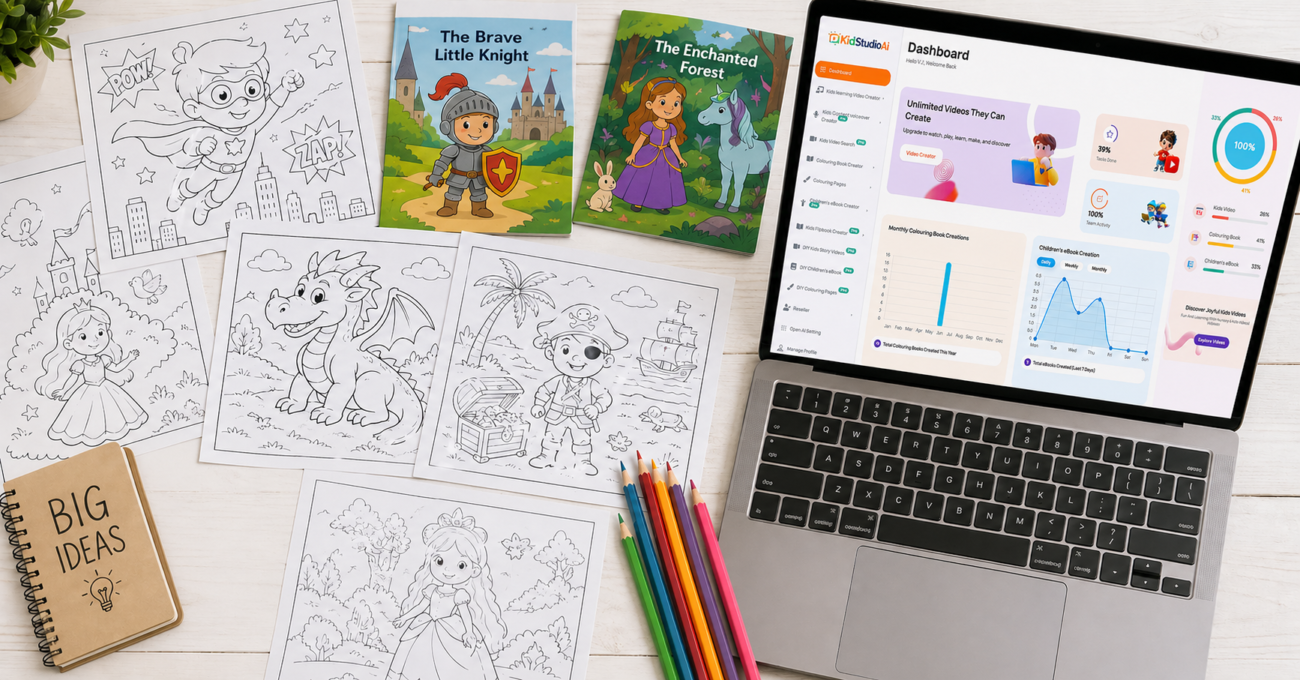
This is exactly what KidStudio AI was built to do. It’s an all-in-one AI platform built specifically around children’s content — kids story videos, illustrated coloring books, printable coloring pages, and an AI content writer, all in one dashboard. Instead of bouncing between five tools, you pick a theme, click generate, and get content already formatted for the platform you’re selling on.
For a deeper look at whether it’s the right tool for your setup, read our full KidStudio AI review.
How to Actually Build a Kids Content Income Stream (Step by Step)
Step 1: Choose your platform and product type
The three most accessible entry points are Etsy printables (coloring pages and activity books), Amazon KDP (children’s illustrated books), and YouTube Kids (story and learning videos). Each has different income timelines — Etsy and KDP can start generating sales within days of publishing; YouTube takes longer to monetize but builds compounding audience value.
Step 2: Pick a niche within kids content
The niches with the strongest current demand include superheroes, fairy tales and fantasy, educational/learning content, bedtime stories, and moral lesson stories. These aren’t trends — they’re evergreen categories. See our full breakdown in the best Etsy printables niches guide for 2026 for niche-by-niche demand analysis.
Step 3: Create content in batches, not one piece at a time
Etsy’s algorithm rewards shops with volume. KDP rewards publishing frequency. YouTube rewards consistency. This is where most solo creators stall — producing one item at a time isn’t a business, it’s a hobby. AI tools make batch creation realistic: you can produce a themed coloring book collection or a week’s worth of story videos in a single session.
Step 4: Set up your listings with SEO in mind
On Etsy, your listing title and tags matter more than your thumbnail. On KDP, your subtitle and keywords drive discoverability. On YouTube, your title and first 24 hours of engagement determine reach. Our step-by-step KDP guide walks through the exact keyword and listing setup process for coloring books.
For Step 3 specifically — if you want to skip the trial and error of stitching tools together — KidStudio AI handles video creation, coloring book generation, AI scriptwriting, voiceovers, and video editing in a single cloud-based dashboard with no monthly subscription. Worth exploring before investing in a separate stack.
What Realistic Results Look Like in This Niche
Let’s be honest about expectations, because this is where a lot of content oversells and loses credibility.
In the Etsy printables market, new shops with well-tagged coloring page collections of 15 to 30 listings typically see their first sales within two to four weeks if the SEO is solid. A shop with 50 to 100 pages in trending niches can realistically generate $300 to $800 per month within the first three to six months. Top performers clear $3,000 to $5,000 monthly — but that comes with volume and audience building, not a single upload.
On Amazon KDP, a children’s coloring book priced at $6.99 to $9.99 earns roughly $2 to $4 per sale in royalties. Publishing 10 to 20 books in related niches creates a catalog that compounds over time. Full KDP mechanics are covered in our children’s coloring book KDP guide.
For YouTube Kids, the path to monetization requires 1,000 subscribers and 4,000 watch hours — typically six to eighteen months for a channel posting two to three times per week. The real leverage is when content ranks in YouTube search and pulls views for years.
None of this is get-rich-quick income. But it is genuinely passive, genuinely scalable, and genuinely accessible to people who aren’t designers — especially when the content creation bottleneck is removed.
The Bottom Line
The kids digital content market isn’t a secret, but it’s still wide open because the production barrier has historically been high. Writing, illustrating, animating, and formatting children’s content to a quality that actually sells takes skills most people don’t have or time most people can’t spare.
What’s changed in 2026 is that AI has caught up specifically to this problem — not just general AI, but tools built around the exact outputs this niche requires.
The most practical next step is to see exactly how the creation process works before committing to any approach. KidStudio AI’s offer page shows what it creates, how the dashboard works, and the current pricing — worth reviewing before you invest time building a manual production workflow that AI can shortcut significantly.
Frequently Asked Questions
Do I need design skills to sell coloring books on Etsy?
No. AI tools designed specifically for kids coloring content now generate market-ready coloring pages without design software. The key is using a tool that produces child-appropriate clean outline illustrations — not photorealistic or overly complex images.
How many coloring pages do I need to open a successful Etsy shop?
Most successful printable shops recommend launching with at least 20 to 30 listings. This gives Etsy’s algorithm enough surface area to show your products across multiple keyword variations. Grouping pages into themed bundles also increases average order value.
Can I legally sell AI-generated children’s content on Amazon KDP and Etsy?
Both platforms permit AI-assisted content as of 2026, with nuances. Amazon KDP requires disclosure of AI-generated images during publishing. Etsy’s policy focuses on misrepresentation — AI-assisted products are allowed as long as you’re accurately representing what you’re selling. Always verify each platform’s current policy before publishing.