

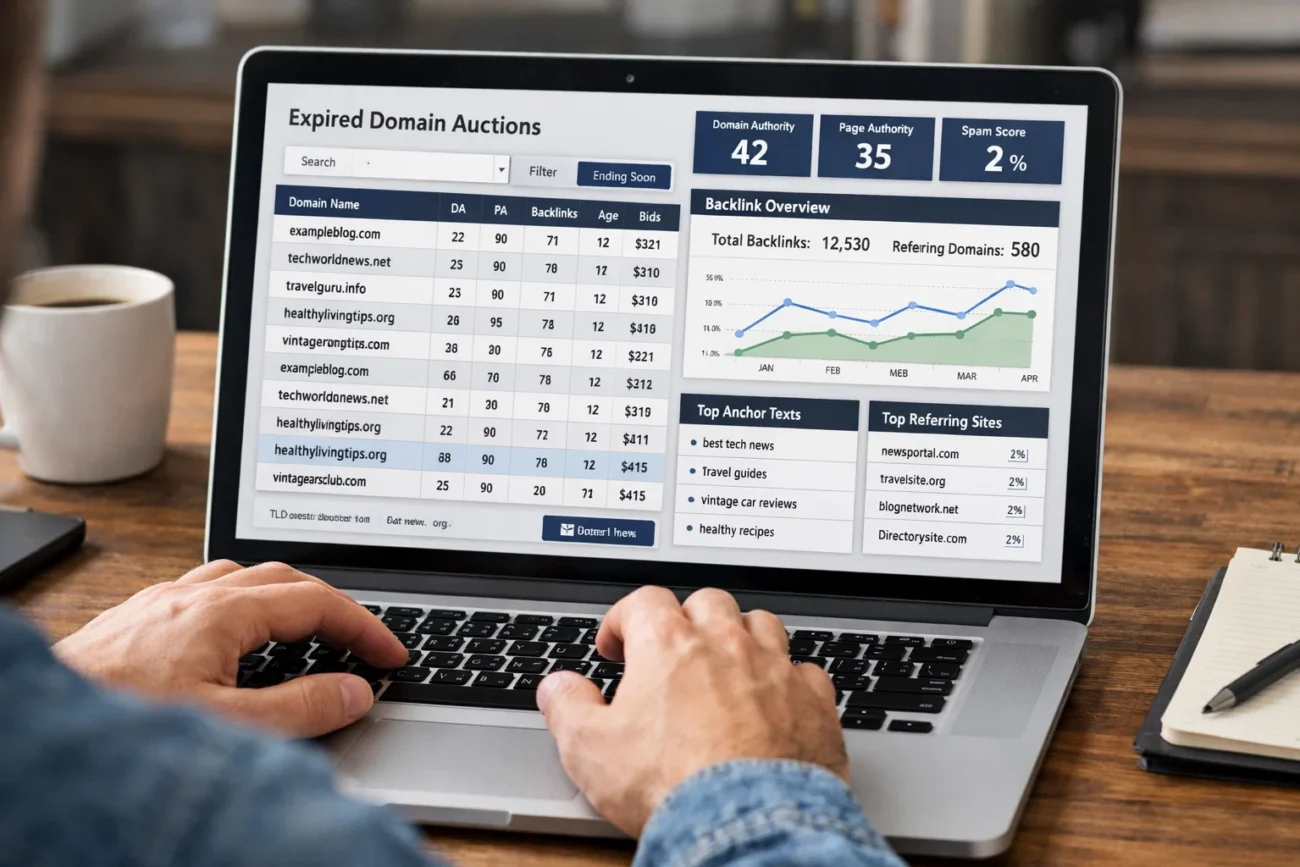
How to Flip Expired Domains for Profit in 2026 (The $11 Strategy)
Every single day, thousands of websites die quietly.
Not because they were bad ideas. Not because they had no traffic. But because their owners moved on, forgot to renew, or simply gave up — and the domain expired, taking all its built-up authority, backlinks, and search history with it.
Most people scroll right past these digital tombstones.
A small group of people buy them for $11.
If you’ve been searching for a legitimate, low-cost way to make money online in 2026 — one that doesn’t require building an audience from scratch, running paid ads, or betting everything on an algorithm — this post is going to show you exactly why expired domain flipping deserves your serious attention, and how the process actually works.
By the end, you’ll understand the core method, what makes a domain worth buying, and how AI has completely changed the economics of this business.
Why Most “Make Money Online” Methods Are Working Against You
Before getting into the expired domain strategy, it’s worth naming what you’ve probably already tried — because it helps explain why this approach is structurally different.
Dropshipping puts you in a price war with thousands of identical stores. Margins are razor-thin, and one bad product review or chargeback can wipe out a month of work.
Paid ads can work — but the moment your budget runs dry, your traffic disappears. You’re renting attention, not owning it. Most beginners burn through their budget before they figure out what converts.
Blogging and content sites are a legitimate long-term play, but they require months of consistent effort before Google starts sending traffic. And a single algorithm update can erase what you’ve built overnight.
Freelancing trades time for money. It’s income, not a business.
The problem with all of these is the same: you’re starting from zero every time, competing for attention in crowded spaces.
Expired domain flipping is different at a structural level. You’re not creating demand — you’re stepping in front of demand that already exists, with an asset that already has authority baked in.
What Makes Expired Domains So Valuable?
What does “domain authority” actually mean — and why does it transfer?
When a website exists for years, it accumulates something search engines genuinely value: trust.
That trust comes in the form of backlinks — other websites linking to it — and search history — a record of real user engagement over time. Domain Authority is a scoring system developed by Moz that predicts how likely a website is to rank in search engine results pages, scored on a scale from 1 to 100. Factors like inbound link quality and quantity, content quality, and SEO performance all contribute to the score. Google doesn’t need to “discover” a 6-year-old domain the way it would a brand new one. The track record is already there.
When a domain expires, that history doesn’t disappear immediately. It lingers — sometimes for months, sometimes indefinitely — in the form of backlinks still pointing at the domain from external sites, existing mentions across the web, and a domain age that signals legitimacy.
That’s the buried treasure.
An expired domain that used to be a local plumbing company might have 40 backlinks from local business directories, a regional news site mention, and three years of crawl history. None of that means anything to a plumber who forgot to renew their hosting. But to someone who knows what they’re looking for? It’s a discounted asset with real underlying value.
The insight that changes everything: you’re not building authority from zero — you’re inheriting it.
If you want to understand exactly how domain authority is calculated and what scores are worth targeting, this breakdown of domain authority covers the mechanics in full — including why expired domains can transfer that authority to a new owner.
And now, with AI tools capable of rebuilding a complete, monetized website in minutes, the final barrier — the technical skill required to actually do something with the domain — has essentially vanished.
How Expired Domain Flipping Actually Works (Step by Step)
Here’s the practical workflow, broken down to its simplest form:
Step 1: Find the domain. Not all expired domains are worth buying. The skill is in knowing what filters to apply — looking for domains with real backlinks (not spam), domain age, search history, and niche relevance. There are specific platforms where these domains surface before they disappear, and most beginners never find them because they’re looking in the wrong places.
Step 2: Acquire it cheaply. Quality expired domains in the $10–$50 range exist — the market for these is largely ignored by institutional buyers who chase premium $50,000+ assets. This is where the opportunity lives.
Step 3: Let AI rebuild the site. This is where 2026 is fundamentally different from 2020. AI tools can generate complete, monetized affiliate sites in minutes — no coding, no design skills, no writing required. You drop in your affiliate links, deploy to hosting, and you’re live.
Step 4: Monetize or flip. This is where the strategy opens up. You can flip the bare domain on platforms like Sedo for a quick $40–$300. You can rebuild the site and list it on Flippa for $99–$500+. Or you can monetize it with affiliate programs, AdSense, CPA offers, or email list building for recurring income — then flip it later for an even higher price because it’s a site with live earnings. For a detailed breakdown of which platform suits which type of sale, see this comparison of Sedo, Flippa, and Afternic.
Step 5: Repeat the system. The value of this model isn’t in a single flip. It’s in running the same process across multiple domains simultaneously.
If you want a documented, step-by-step system that covers all six monetization paths — including the exact domain source most practitioners never share publicly — Buried Profits AI was built specifically for this. It includes live case studies recorded while the method was actively being run, not after the fact.
What Kind of Results Are Realistic?
The domain aftermarket is not a niche curiosity. According to NameBio data, approximately 190,300 domain name sales were recorded in 2025, with a total dollar volume exceeding $244 million — up 31.9% compared to 2024, driven by a higher number of transactions rather than higher individual sale prices. That’s a functioning, liquid market generating real transactions every single day. You can browse the live data at NameBio.com, which tracks sales across all major auction platforms in real time.
Now, let’s keep expectations grounded — because expired domain flipping isn’t a “get rich overnight” scheme, and anyone who tells you otherwise is selling something different.
Here’s what a realistic trajectory looks like:
- First flip (days 1–14): A domain bought for $9–$11, listed on Sedo as a bare domain. Realistic return: $40–$100. Small, but it proves the model.
- First rebuilt site (weeks 2–4): The same domain type, rebuilt with AI into a monetized site, listed on Flippa. Realistic return: $75–$200 at reserve price — higher upside with competitive bidding.
- Stacked monetization (30–90 days): A domain rebuilt as an affiliate site, generating passive commissions through networks like Impact or ClickBank while you continue sourcing new domains. Multiple income streams from a single $11 asset.
In documented results from practitioners running this exact method, three domains bought for under $33 total sold for a combined $494+ on Sedo. A rebuilt site sold on Flippa for $99 while still in mid-production. These aren’t outliers — they’re what a repeatable process looks like when you run it correctly.
Industry observers note that strength in the domain market is expected to carry into 2026, with AI-related advancements continuing to fuel sales activity. The ceiling scales with volume. One domain is a test. Five running simultaneously is an income stream. Ten is a business.
The expired domain market is real, documented, and growing. NameBio recorded nearly $250 million in domain name sales closed in 2025 alone — and that figure is expected to rise further as previously unreported sales are publicized.
The core insight is simple: other people’s abandoned assets still have value, and AI has made it easier than ever to extract that value.
You don’t need web development skills. You don’t need a marketing budget. You don’t need an existing audience. You need a reliable process for finding the right domains and a clear system for what to do with them.
That’s exactly what Buried Profits AI documents — 10 modules, six monetization methods, a live case study recorded in real time, and the exact domain source that most people running this strategy never share publicly. If you’re serious about testing this method, it’s worth a look.
Frequently Asked Questions
Do you need technical skills to flip expired domains? No. The rebuilding step — which used to require web development knowledge — is now handled entirely by AI tools. The filtering and sourcing process is taught step-by-step, so there’s no assumed background knowledge required.
How much money do you need to get started? The domain acquisition cost is typically $9–$15 per domain. You can start with a single domain to test the method before scaling. There are no mandatory recurring costs — the platform covered in Buried Profits AI includes free hosting as part of the system.
How fast can you flip your first domain? Bare domain flips on Sedo can happen within days to a few weeks depending on niche and pricing. Rebuilt site flips on Flippa have a longer window but higher return potential. Most people running this method see their first transaction within 2–4 weeks of starting.