

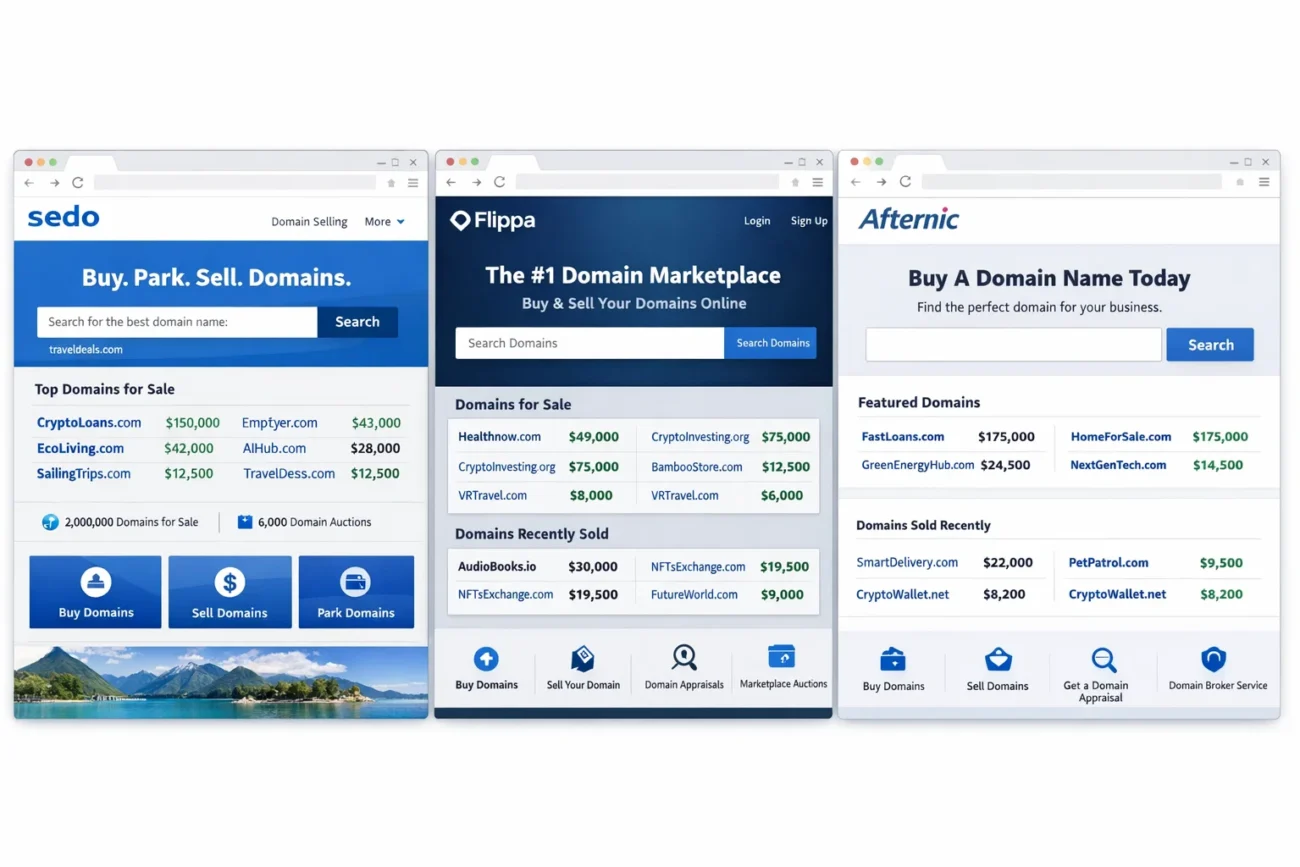
Sedo, Flippa, and Afternic all let you sell domains — but they work very differently. Here’s an honest breakdown of fees, audiences, and when to use each platform.
Best Platforms to Sell Domains in 2026: Sedo vs Flippa vs Afternic
You’ve found a quality expired domain. Maybe you’ve rebuilt it into a monetized site. Now comes the question everyone eventually hits: where do you actually sell the thing?
The three platforms most domain flippers use — Sedo, Flippa, and Afternic — are not interchangeable. They attract different buyers, charge different fees, suit different domain types, and produce very different outcomes depending on what you’re selling.
Choosing the wrong platform doesn’t mean you won’t sell — it means you’ll sell slower, for less, or pay more in commissions than you needed to.
This post breaks down each platform honestly: what it’s best for, what it costs, and how to decide which one to use for your specific situation. If you’re newer to the strategy and want to understand the full acquisition-to-sale process first, the expired domain flipping guide covers the end-to-end method before you get to the selling stage.
Why Platform Choice Actually Matters
Before comparing platforms, it’s worth understanding what you’re actually selling — because that determines everything.
A bare domain (just the domain name, no site) and a rebuilt monetised site are fundamentally different products. Bare domains attract domain investors looking for resale or branding opportunities. Rebuilt sites attract buyers who want an asset that’s already earning or ranking — a different buyer with a different budget and different motivations.
The top platforms in 2026 are Sedo (largest international reach, 10–15% commission), Afternic (GoDaddy network, 15–25% commission with broad distribution), Flippa (website and startup focus, 10% commission), and GoDaddy Auctions (highest raw volume). Each occupies a different niche in the market, and the best sellers use them strategically rather than defaulting to one.
Sedo — Best for Bare Domain Sales and International Buyers
Sedo operates one of the world’s largest domain inventories with millions of listings across all TLDs. It supports fixed-price, auction, and make-offer transaction formats, covers 17 languages, and handles escrow for every sale. Commission ranges from 10% to 20% depending on transaction type.
Sedo’s biggest strength is its global buyer pool. Around 43% of Sedo buyers are European, and the platform offers multi-language support and local payment methods — making it the go-to choice for sellers targeting international businesses or selling non-.com extensions like .de, .fr, or .co.uk.
For the expired domain flipping strategy, Sedo is typically the first stop for bare domain sales — especially when the domain has clear niche value but doesn’t yet have a rebuilt site. The platform’s auction format allows competitive bidding to drive prices up when demand exists, and the make-offer format works for domains where the right buyer will pay a premium but you don’t want to anchor the price too low.
Sedo pros: Global reach, multiple listing formats, escrow included, no upfront listing fees
Sedo cons: Commission can reach 20%, interface feels dated, lower volume than GoDaddy
Best for: Bare domains with clear niche value, international buyer targeting, fixed-price and make-offer listings
Afternic — Best for Distribution Reach on .com Domains
Afternic, operated by GoDaddy, specializes in distribution reach. Listings on Afternic are syndicated to 100+ registrar partners, meaning your domain appears as a premium option when buyers search at GoDaddy, Namecheap, Network Solutions, and dozens of others simultaneously. Standard commission is 20%.
That distribution network is Afternic’s core differentiator. When someone types a domain into a registrar search bar and it’s not available, your listing shows up as a premium option — right in front of a buyer who is actively searching for that exact name or something close to it. You don’t need to drive traffic to a listing; the buyers come to you through the registrar ecosystem.
The tradeoff is the 20% commission, which is the highest of the three main platforms. For lower-priced flips in the $40–$150 range, that cut takes a meaningful chunk. For domains priced at $500+, the distribution reach typically justifies the cost.
Average time to sale on Afternic is approximately 60 days for correctly priced domains.
Afternic pros: Unmatched distribution through 100+ registrar partners, passive exposure without active marketing effort Afternic cons: 20% commission, less suited for rebuilt sites or low-priced flips
Best for: .com domains priced $500+, sellers who want passive exposure without active marketing
Flippa — Best for Rebuilt Sites with Traffic or Earnings
Flippa is a popular marketplace where you can buy and sell not only domains but also websites, apps, and online businesses. It’s well suited for digital assets with existing income or SEO value. Buyers can use advanced filters for price, age, and domain extension, and auctions are active and transparent with escrow protection included.
Where Flippa diverges from Sedo and Afternic is its buyer base. Flippa buyers are typically entrepreneurs and online business operators — not domain investors. They’re looking for assets that are already doing something: generating traffic, earning ad revenue, or producing affiliate commissions.
This is where domain authority directly affects your sale price. A rebuilt site with a meaningful DA score, real backlinks, and organic traffic history is a very different Flippa listing than a bare domain. Buyers on Flippa filter by metrics — traffic, earnings, DA — and a site that scores well on those inputs commands a premium bid.
Domain-only sales on Flippa tend to perform poorly. The recommended approach is to add a basic WordPress blog, 10–20 posts, and 3–6 months of traffic data — which can two to four times the sale price compared to a bare domain listing.
This is directly relevant to the expired domain flipping method: a domain rebuilt with AI into a live affiliate or AdSense site is a Flippa listing, not just a Sedo listing. The same $11 domain that might sell for $75 on Sedo as a bare asset could sell for $200–$500+ on Flippa once it has content, a monetization setup, and some traffic history.
Flippa charges listing fees from $29 to $99 plus a success fee upon sale. That upfront cost is worth accounting for — unlike Sedo and Afternic, you’re paying regardless of whether the domain sells.
Flippa pros: Entrepreneur buyer base willing to pay premium for earning sites, competitive auction bidding, escrow included Flippa cons: Upfront listing fee, bare domains perform poorly, requires more listing preparation
Best for: Rebuilt sites with content, traffic history, or active monetization — not bare domains
How to Decide Which Platform to Use
The decision comes down to what you’re selling:
Bare domain, clear niche value, $50–$300 target price → Start with Sedo. List on Afternic simultaneously if it’s a .com with broad appeal.
Rebuilt site with content and monetization, $100–$500+ target → Flippa is your primary platform. The buyer base and auction format suit this asset type far better.
Premium .com domain, $500+ target, broad commercial appeal → Afternic’s distribution network justifies the 20% commission at this price point.
Any domain → Multi-listing across platforms where terms allow increases exposure. Sedo and Afternic can often be listed simultaneously on bare domains without conflict — just remove all listings the moment a sale completes.
The platform you choose also shapes how you build and price the asset before you list it. A Flippa flip requires a rebuilt site with time to accumulate traffic data. A Sedo flip can happen the day you register the domain. Understanding your exit before you acquire is what separates consistently profitable domain flippers from people who buy first and figure out the rest later.
If you want the full documented framework — from sourcing the right expired domains through to platform-specific listing strategies — Buried Profits AI covers every stage in detail, including the exact rebuild process that turns a bare domain into a Flippa-ready asset.
Frequently Asked Questions
Can I list the same domain on multiple platforms at once? Generally yes for fixed-price or make-offer listings on Sedo and Afternic simultaneously — though you must remove all listings immediately upon sale to avoid double-selling. Auction listings typically require exclusivity for the duration of the auction. Always read each platform’s current terms before multi-listing.
Does Flippa work for domain-only sales without a built site? Technically yes, but results are typically poor. Flippa’s buyer base is predominantly looking for operating online businesses, not bare domains. A domain without content, traffic, or monetization will struggle to attract bids. If you want to sell a bare domain, Sedo or Afternic will outperform Flippa in most cases.
Which platform has the lowest fees? Sedo and Afternic charge no listing fee — you only pay commission on a successful sale. Flippa charges upfront listing fees ($29–$99) plus a success fee. For low-priced domains, that upfront cost can significantly reduce net profit, so Sedo is typically more cost-effective for sub-$200 bare domain flips.