

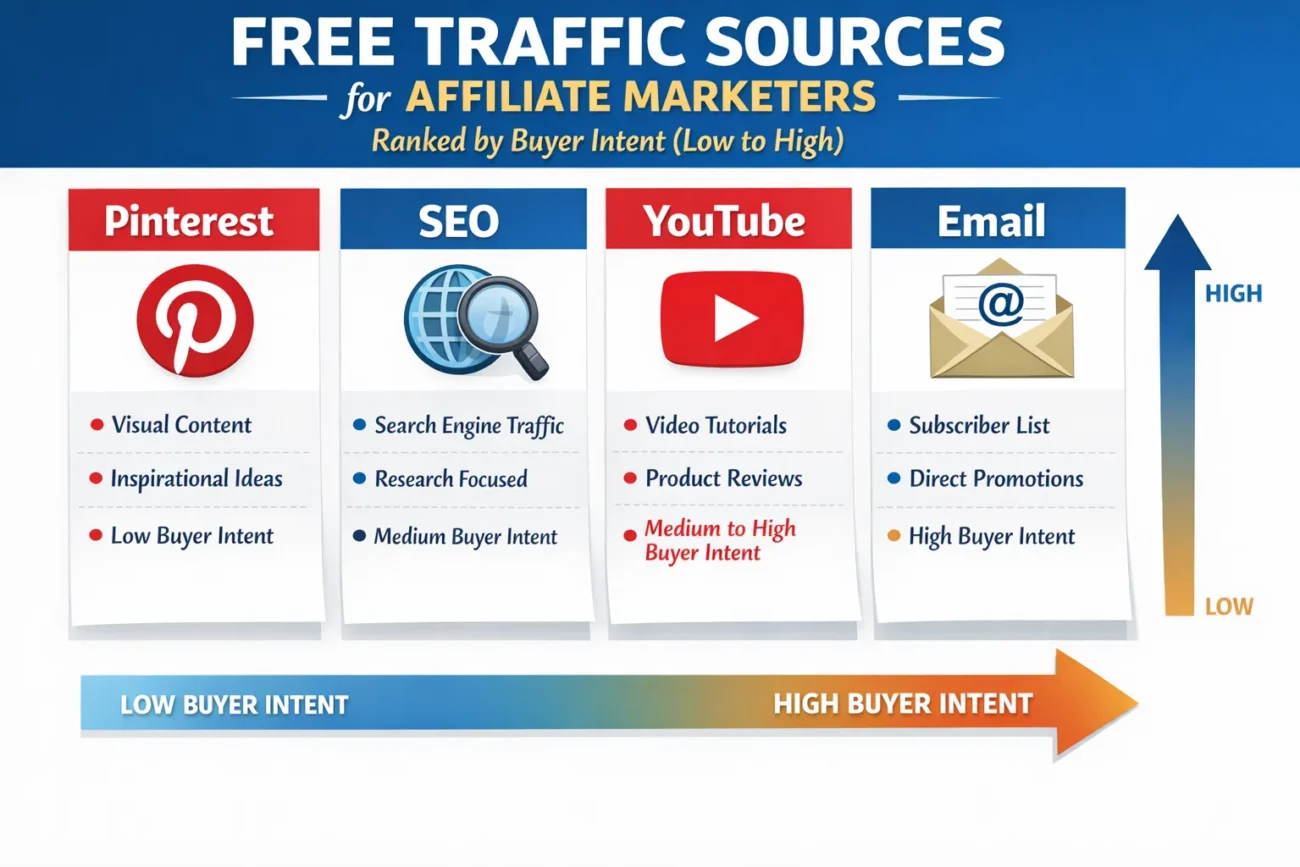
7 Free Traffic Sources for Affiliate Marketers (Ranked by Buyer Intent)
Every affiliate marketer eventually hits the same wall: the offer is solid, the landing page converts, but there’s no traffic — or the traffic that exists costs too much to make the numbers work.
Paid ads solve the volume problem but introduce a margin problem. Google Ads, Meta, and native advertising platforms have all seen cost-per-click increases that have squeezed affiliate margins to the point where many niches are simply unprofitable without serious scale behind them.
Free traffic is the answer — but not all free traffic is equal. The difference between a source that builds a real business and one that wastes months of effort comes down to one variable: buyer intent.
This post ranks the seven most viable free traffic sources for affiliate marketers by how much purchase intent the audience brings with them — because traffic that converts is the only traffic worth chasing.
Why Buyer Intent Is the Only Metric That Matters
Before the rankings, a framing note worth internalising.
Vanity metrics — impressions, followers, page views — don’t pay affiliate commissions. What matters is whether the person arriving at your link is already inclined to buy something.
High-intent traffic comes from people who typed a specific question into a search engine, searched for a product on a visual platform, or clicked a link in an email they subscribed to. Low-intent traffic comes from people who were scrolling passively and happened to see your content. The gap in conversion rates between these two types of visitors is not small — it’s often the difference between a profitable campaign and a money-losing one.
According to research published by Nielsen, consumers who actively search for information before purchasing convert at dramatically higher rates than those reached through passive interruption advertising. The platforms below are ranked with that distinction in mind.
The 7 Best Free Traffic Sources, Ranked
1. SEO (Google Organic Search) — Highest Intent, Slowest Build
Buyer intent: ★★★★★ Ease of entry: ★★ Time to results: 6–12 months
Someone who types “best protein powder for muscle gain under $40” into Google is moments away from a purchase decision. Organic search traffic is the gold standard for affiliate buyer intent — it’s the reason SEO-based affiliate sites can generate substantial passive income with no ongoing ad spend.
The catch is timeline. A new domain with new content realistically takes 6–12 months to rank competitively for buyer-intent keywords, and it requires real technical investment: on-page optimization, link building, site speed, and consistent content output. According to Ahrefs’ analysis of how long it takes pages to rank, fewer than 6% of newly published pages reach Google’s top 10 within a year — underscoring how competitive the channel has become.
For affiliates with patience and a long-term orientation, SEO remains the single most valuable free traffic investment. For affiliates who need results in weeks rather than quarters, it needs to be paired with something faster.
2. Pinterest — High Intent, Fast Entry, Massively Underused
Buyer intent: ★★★★★ Ease of entry: ★★★★ Time to results: 3–6 weeks
Pinterest is the most underrated free traffic source in affiliate marketing, and the gap between its potential and how many affiliates actually use it is genuinely remarkable.
Like Google, Pinterest functions as a search engine — not a social feed. Users arrive with specific intentions: planning purchases, researching products, looking for ideas in categories they’re actively interested in. According to Pinterest’s business research, the vast majority of weekly Pinners have discovered a new brand or product on the platform — one of the highest brand discovery rates of any major platform.
What separates Pinterest from Google for affiliates is the barrier to entry. You don’t need domain authority, backlinks, or a 6-month content runway. A well-optimised pin in a buyer-intent niche can surface in search results within weeks of posting.
The practical challenge is consistency. Pinterest rewards regular daily pinning activity, which is time-intensive to maintain manually across multiple boards. Affiliate marketers who’ve cracked Pinterest at scale typically use automation tools like Pinflux to handle scheduling, content repinning, and audience growth automatically — freeing them to focus on the offer side rather than the daily content operations.
Getting the setup right before adding automation is important. If you haven’t configured your Pinterest business account correctly yet, this step-by-step guide covers everything: how to set up a Pinterest business account from scratch. Once the foundation is solid, you can layer automation on top of it effectively.
For a deeper look at how the automation works and what realistic traffic results look like, this is worth reading: Pinterest marketing automation: get traffic fast.
For niches with strong visual components — home, fashion, fitness, food, finance, parenting, self-improvement — Pinterest should be the first free traffic source any affiliate seriously tests.
3. YouTube — High Intent, High Production Bar
Buyer intent: ★★★★ Ease of entry: ★★ Time to results: 2–6 months
YouTube search traffic carries strong buyer intent, particularly for review and comparison content. Searches like “X vs Y,” “best X for Y,” and “is X worth it” convert extremely well for affiliate offers because the viewer is explicitly in evaluation mode — they’ve already narrowed their options and are looking for the final push.
YouTube videos compound over time in the same way SEO content does. A well-ranking video continues driving affiliate clicks for years with no additional work or promotion. And as the second-largest search engine in the world, the audience scale is enormous.
The barrier is production. Even minimal-quality videos require equipment decisions, editing time, and the willingness to be on camera or invest in voiceover and screen-recording setups. It’s a higher operational lift than any other platform on this list — which is precisely why the affiliates who do it consistently have a meaningful advantage over those who don’t.
4. Email Marketing — Highest Conversion Rate, Requires an Existing List
Buyer intent: ★★★★★ (for warm audiences) Ease of entry: ★★★ (requires list building first) *Time to results: Immediate — once the list exists
Email converts better than every other channel on this list for one reason: the person opted in. They gave you explicit permission to market to them. That voluntary relationship is worth more than any algorithmic impression or passive scroll.
The limitation is structural. Email requires an existing audience — you can’t send cold email to affiliate offers at scale without serious deliverability and legal complications. This makes email a multiplier for affiliates who’ve already built a list through another traffic source, not a starting point on its own.
If you’re generating any traffic from the sources above and not capturing emails, you’re leaving a significant portion of your potential revenue on the table. A visitor who becomes a subscriber becomes a recurring buyer. That compounding is where affiliate income stabilises.
5. Reddit — Niche-Specific, Conversion-Hostile if Done Wrong
Buyer intent: ★★★ Ease of entry: ★★★ *Time to results: Immediate to weeks
Reddit communities are some of the most engaged, niche-specific audiences on the internet. The right subreddit for your offer can contain tens of thousands of highly motivated buyers in a specific category — people who discuss, compare, and recommend products actively.
The challenge is Reddit’s culture. Overt promotion is penalized by communities and frequently removed by moderators. Affiliate links posted directly rarely survive. The approach that works on Reddit is genuine participation — answering questions, building credibility over time, and referencing relevant resources only when contextually appropriate and genuinely helpful.
For affiliates willing to invest time in real community participation, Reddit can be a meaningful traffic driver. For affiliates looking to scale quickly or run multiple offers simultaneously, it’s not the right primary lever.
6. Quora — Long-Tail Search Traffic, Reliable Slow Burn
Buyer intent: ★★★ Ease of entry: ★★★★ *Time to results: 1–3 months
Quora answers rank in Google. This is the underappreciated mechanic that makes Quora worth including in any affiliate traffic strategy. A well-written answer to a buyer-intent question — “What’s the best software for X?” or “Is Y worth buying in 2025?” — can surface in Google search results and drive affiliate clicks for months after it was written.
The quality bar for answers is real. Thin, low-effort responses get collapsed by the platform and ignored by readers. A genuinely helpful, detailed answer that references your offer in a natural, contextually relevant way — not as a hard sell — is what generates sustained traffic. One strong Quora answer in the right category can outperform months of social posting.
7. Facebook Groups — Community-Dependent, Highest Variance
Buyer intent: ★★ Ease of entry: ★★★ *Time to results: Weeks to months
Facebook Groups occupy a complicated middle ground. A highly active group in the right niche contains engaged buyers who discuss, recommend, and purchase products regularly. But Facebook’s organic reach for group content has declined significantly, group admins vary enormously in what promotional content they permit, and the audience is typically scrolling passively rather than searching with active intent.
Facebook Groups work best as a supplementary source for affiliates who are already embedded in a community — not as a primary driver. Building your own group, while a longer-term investment, gives you full control over the audience and removes the dependency on another admin’s rules.
How to Stack These Sources for Maximum Impact
The affiliates generating consistent, sustainable commissions from free traffic aren’t relying on a single channel. The stack that produces the most reliable results:
Pinterest for fast entry — gets targeted, buyer-intent traffic moving within weeks, without the production demands of YouTube or the timeline of SEO.
SEO for long-term compounding — builds domain authority and content assets that drive traffic for years, entirely passively once established.
Email capture on every page — converts traffic from both channels into a list you own outright, independent of any algorithm or platform policy change.
Pinterest is the most accessible starting point for most affiliate niches. The setup curve is low, the audience intent is genuinely high, and automation tools make it scalable without a full-time time commitment. Getting the account foundation right is the first step — this guide walks through exactly how: how to set up a Pinterest business account from scratch.
Once the account is configured, understanding how automation turns it into a hands-off traffic system is the logical next step. The full breakdown of how that works — and what results look like across different niches — is here: Pinterest marketing automation: get free traffic fast.
Frequently Asked Questions
What is the best free traffic source for beginner affiliate marketers? Pinterest is the most accessible starting point for most beginners. It has lower competition than Google SEO, doesn’t require video production like YouTube, and reaches an audience with genuine purchase intent. Results typically appear within 3–6 weeks of consistent activity — far faster than SEO, and with far less production overhead than YouTube.
Can you do affiliate marketing without paid ads? Absolutely. Many of the most successful affiliate marketers built their businesses entirely on free traffic — primarily through SEO, Pinterest, YouTube, and email. Paid ads can accelerate growth but introduce margin risk and require constant budget management. Free traffic sources, once established, compound over time and cost nothing to maintain.
How long does it take to see results from free traffic sources? It depends on the source. Pinterest typically shows meaningful results within 3–6 weeks. YouTube takes 2–6 months for a channel to gain real traction. SEO takes 6–12 months for competitive keywords. Email converts immediately once you have a list large enough to generate volume. Stacking Pinterest with SEO gives you near-term traffic while the longer-term asset builds in the background — which is why that combination is the most common starting stack among successful affiliate marketers.