

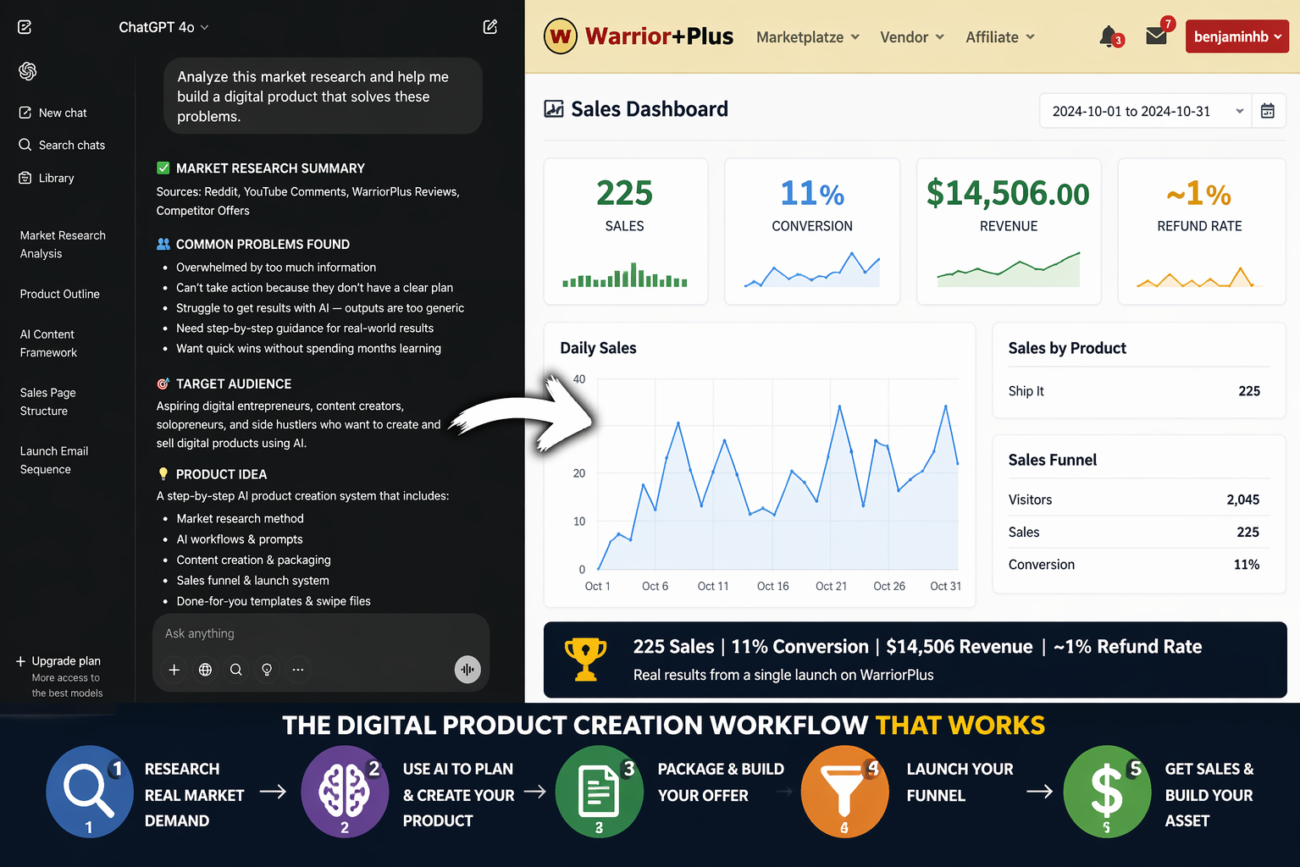
Learn how to create a digital product with AI and launch fast. Follow a proven system to go from idea to sales in one weekend.
You’ve been circling the idea for months. Maybe longer. You have the knowledge, the niche, probably even a rough outline somewhere in a Google Doc you haven’t opened since March. And yet — no product. No funnel. No sales.
You’ve read the guides. You’ve watched the tutorials. You’ve bought at least one course that promised to make this easy. And still the thing isn’t built, because every system you’ve tried starts with something vague like “brainstorm your topic” and then hands you off to a blank page.
This post isn’t going to do that.
By the time you finish reading, you’ll understand the exact workflow for creating a digital product with AI that actually converts — the same approach used across four real launches that generated $14,606 in six months with no existing audience, no team, and no paid ads. More importantly, you’ll know precisely what’s been breaking your process — and what to do instead.
Why AI Makes Product Creation Harder Before It Makes It Easier
Here’s the frustrating truth most guides won’t tell you: AI doesn’t solve the hardest part of creating a digital product. In fact, if you skip one foundational step, AI actively makes things worse — faster.
The typical approach looks like this: open ChatGPT, type something like “help me create a course about email marketing for beginners,” and get back a plausible-sounding outline that could belong to any of a thousand products already on the market. You polish the content. You build the thing. You launch it. And then nothing — because the product wasn’t built from what real buyers actually want. It was built from what AI predicted a generic product in your category should look like.
Most failed digital product launches don’t fail at the tech setup or the copywriting. They fail at the research stage — or, more accurately, the missing research stage. When you skip market validation and go straight to content generation, you end up with something that’s technically complete but emotionally invisible to buyers.
AI doesn’t fix broken process. It amplifies it. Feed it bad inputs and you get confident-sounding garbage, faster. That’s the real problem.
AI doesn't fix broken process — it amplifies it.
Feed it bad inputs and you get confident-sounding garbage, faster."
The creators who consistently launch products that sell share one habit: they spend serious time understanding their market before they write a single word of content. The AI comes second. The research comes first.
How to Create a Digital Product With AI That Actually Sells
What is the “Research Pack” method — and why does it change everything?
The core insight behind the most effective AI product creation workflow is something called a Research Pack — a structured document that collects real market signals before you ever open an AI chat window. This isn’t a mood board or a brainstorm. It’s a deliberate pull of buyer language, competitor gaps, and audience frustration signals from the places where real buyers talk: Reddit threads, YouTube comments, product reviews, and sales pages from competing offers.
Once you have this pack assembled, something significant changes. Instead of asking AI to invent a product for an imaginary customer, you’re feeding it the actual words, fears, and desires of real people who have already demonstrated they spend money in your niche. The AI’s output transforms from generic to market-specific — and that specificity is exactly what separates a 1% conversion rate from an 11% one.
The second component is what’s called preframing — a method for setting AI context so it stays coherent across every step of production, from outline to content to sales copy. Most people use five separate chat sessions and wonder why their product sounds like it was written by a committee. Preframing keeps a single consistent voice and product logic throughout.
This two-part foundation — Research Pack plus preframing — is the documented core of Ship It, a step-by-step system built from four actual WarriorPlus launches. If you want to understand how it performs before you decide, there’s a full breakdown in the Ship It review.
The Step-by-Step Process: From Zero to a Live Digital Product
Here’s how the full workflow runs in practice:
01 — Build your Research Pack first. Spend 2–3 hours on Reddit, YouTube, and your top 3 competitor offers. You’re looking for phrases buyers use to describe their pain, objections that appear repeatedly in reviews, and gaps that competitors don’t address. Save everything in one document.
02 — Preframe your AI before you generate anything. Open a single chat session and feed it your Research Pack before asking it to do anything else. Tell it who the audience is, what they’re frustrated by, what they’ve already tried, and what success looks like. This context shapes every output that follows.
03 — Build the outline from market signals, not categories. Rather than creating a generic table of contents, structure each module around a specific problem your research identified. Buyers finish products that feel written for them. They abandon products that feel like college syllabi.
04 — Use a Style Blueprint for content creation. Before writing, give AI three to five examples of your own writing — emails, social posts, anything you’ve actually written. Ask it to identify your voice characteristics before producing any content. This eliminates the robotic AI tone that kills credibility.
05 — Build the funnel and sales page using the same research. Your sales copy should use the exact phrases from your Research Pack. If buyers say they’re “tired of overthinking and never launching,” that phrase belongs in your headline — not a polished paraphrase of it. The full process for writing sales copy this way is covered in How to Write a Sales Page That Converts (AI Prompt Framework).
06 — Use a launch sequence that starts before cart open. A 7-email sequence beginning three days before launch consistently outperforms a single announcement. The pre-launch emails build anticipation. The cart-open email converts it.
If you’re launching on WarriorPlus and need to understand how the platform actually works — products, offers, affiliates, funnel structure — WarriorPlus for Beginners: How the Marketplace Works for Vendors covers all of it.
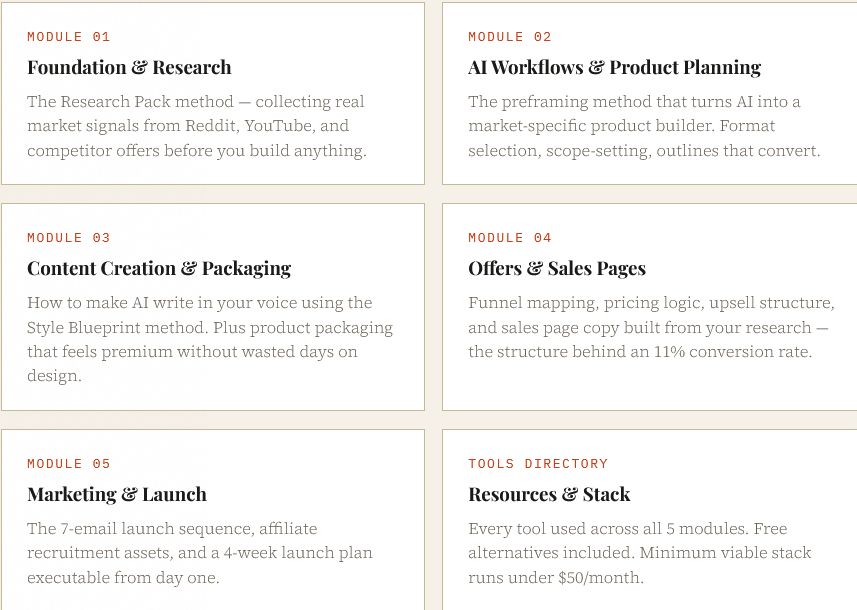
Here’s what the five modules cover in sequence:
What Realistic Results Look Like
The numbers worth paying attention to aren’t the revenue total — it’s the conversion rate and refund rate, because those reveal whether the product actually delivered on what it promised.
Across four WarriorPlus launches built with this workflow: an 11% conversion rate on a cold marketplace audience, and under 1% refunds. For context, a typical WarriorPlus conversion rate for a new vendor with no existing audience runs between 2–5%. An 11% rate with 225 sales on a single launch — without a big list, without paid ads, without an established name in the niche — is the direct result of launching a product built from real market research rather than assumptions.
The realistic before-and-after for someone following this process: before, you’re spending more time researching systems than running them, producing AI output that sounds generic, and stalling somewhere between outline and delivery file. After one focused weekend following a documented research-to-launch process — a complete digital product, a live funnel on WarriorPlus, and affiliate partners able to drive traffic on launch day.
The gap between those two states isn’t talent or technical skill. It’s process. Specifically, having a proven one rather than assembling your own from scratch mid-execution.
The Takeaway
If there’s one thing to take from this post, it’s that the research step isn’t optional — it’s the entire engine. Skipping it and going straight to content generation with AI produces something that looks complete from the outside and converts at near zero. Doing it properly — even just a few hours of deliberate market signal collection before you open a single AI window — changes what AI can build for you.
You don’t need a big audience. You don’t need paid ads. You need a product built from what real buyers actually said, and a funnel that reflects it.
If you’re ready to stop circling and start shipping, the complete documented system is Ship It — five modules covering research through launch, built from the four launches that produced the numbers above. For the full breakdown of what’s inside, read the Ship It review before you decide.
FAQ
Do I need technical skills to create a digital product with AI? No. The workflow uses Google Docs, free AI tools, and WarriorPlus. If you can type and follow a sequential process, you have the technical baseline required. The skill ceiling here is research discipline, not software competence.
How long does it realistically take to create and launch a digital product? Following a documented system, a first product can go from research to live funnel in a single weekend — roughly 12–16 focused hours. The caveat is that “a weekend” assumes you’re following a tested workflow rather than making structural decisions from scratch while you build. With a clear process, the research phase alone is a defined 2–3 hour session.
Does this work if I have no existing audience or email list? Yes. The 225 sales referenced throughout this post came predominantly from people who had never heard of the vendor before they bought. The WarriorPlus marketplace provides cold traffic, and affiliates drive additional buyers on launch day. Your list grows as a byproduct of launching, not a prerequisite for it.