

You wrote the product. You built the funnel. You opened a blank Google Doc and typed “Headline:” at the top — and then spent forty-five minutes reading other people’s sales pages instead of writing yours.
The blank sales page is one of the most reliable productivity sinkholes in digital marketing. Not because writing is hard, but because most people don’t know the structure they’re supposed to be filling in. They know a sales page needs a headline, a story, some bullet points, and a call to action. But in what order? Built around what logic? Answering which objections, in which sequence?
This post answers all of that — and shows you how to use AI to execute it, so you’re not staring at a cursor. By the end, you’ll have a repeatable AI prompt framework for writing sales pages that are built from your market research, written in your voice, and structured around the conversion logic that actually works.
If you haven’t built your Research Pack yet — the market data document that makes every prompt in this framework produce usable output — start with How to Create and Launch a Digital Product With AI (Step-by-Step) first. This post picks up where that one leaves off.
Why AI-Written Sales Pages Usually Don’t Convert
The first instinct most people have when facing a blank sales page is to open ChatGPT and type something like: “Write me a sales page for my course about [topic].” What comes back looks plausible. It has a headline. It has bullets. It has a call to action. And it converts at roughly zero percent.
Here’s what went wrong: the AI had no market context. It didn’t know your specific buyer’s frustration. It didn’t know what they’ve already tried and why it failed. It didn’t know the precise language they use to describe their problem — the phrasing that makes a reader stop and think “that’s exactly it.” So it generated a generic version of a sales page for a generic version of your offer.
A sales page doesn’t fail because the copy is bad. It fails because the copy isn’t talking to anyone specific.
The fix isn’t a better AI tool. It’s a structured prompt framework that feeds AI the right inputs before asking it to write anything. That’s the approach that produced an 11% conversion rate on a cold WarriorPlus audience — and it’s what we’ll walk through here.
What Makes a Sales Page Actually Convert?
Is there a proven structure for high-converting sales pages?
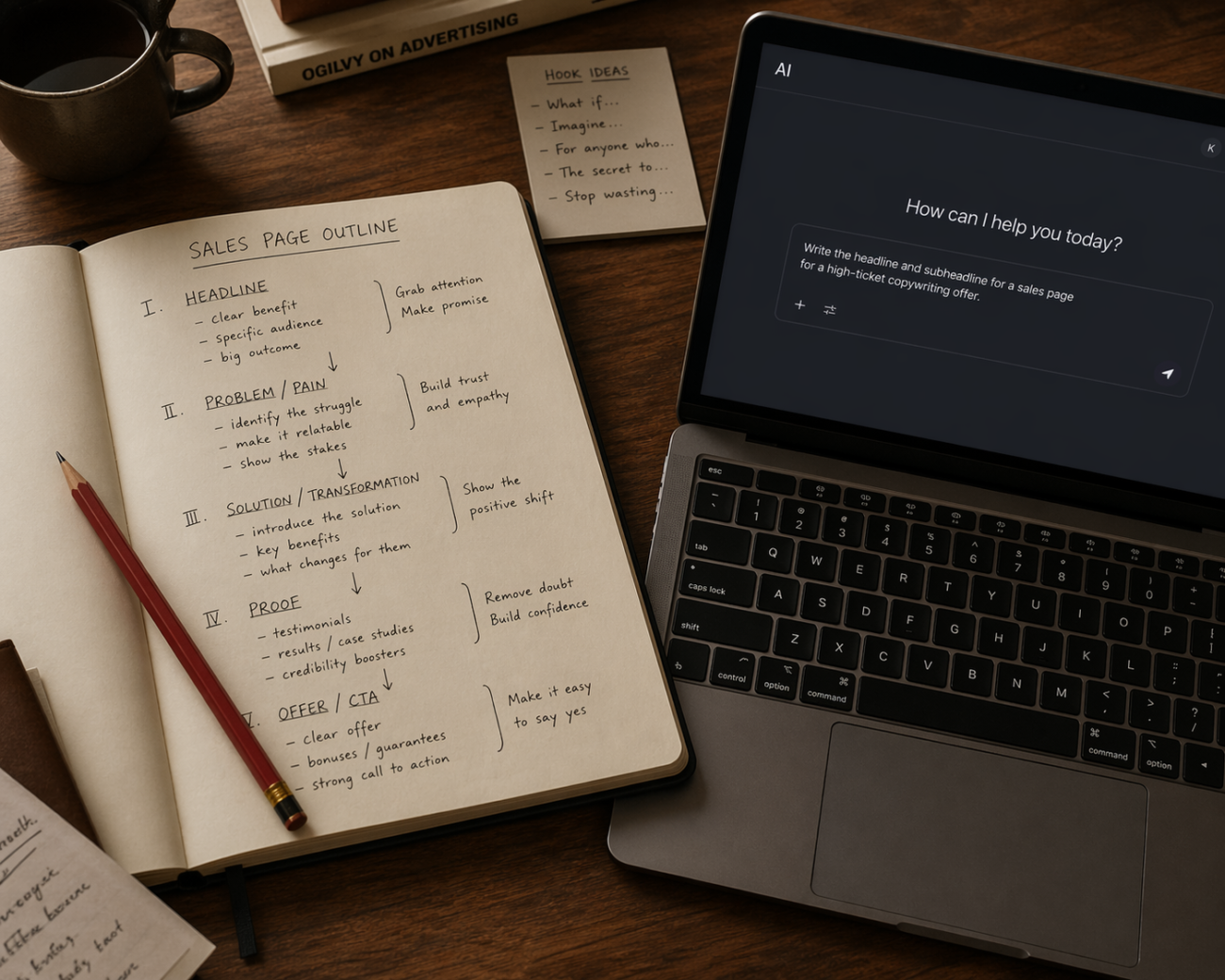
Yes — and it maps to a predictable sequence of psychological states a buyer moves through before purchasing. Your sales page needs to guide them through all five in order. Skip one and conversions drop. Rearrange them and the page stops making emotional sense to the reader.
Stage 1 — Interrupt. Stop the right person mid-scroll with a headline that names their specific situation. Not “Make Money Online.” More like: “You’ve Bought Three Courses and You Still Haven’t Launched Anything.” The headline’s only job is to make the right reader keep reading.
Stage 2 — Identify. Make them feel recognized. A short paragraph that mirrors their internal experience back at them, using the exact language from your market research. When a buyer reads this and thinks “how does this page know that” — you’re on the right track.
Stage 3 — Agitate. Name what’s at stake if nothing changes. Not to be manipulative — to be honest. The cost of inaction is real. The buyer is already aware of it. Naming it clearly demonstrates that you understand their situation.
Stage 4 — Solution. Introduce your offer as the mechanism that resolves the specific problem you’ve just described. Not a list of features. A bridge from their current state to their desired outcome — with a clear explanation of what makes your approach different from what they’ve already tried.
Stage 5 — Justify. Handle the skepticism. Proof, results, guarantees, FAQs. Cold traffic doesn’t know you. They need a reason to trust before they click. This is where your numbers — conversion rate, refund rate, sales count — carry real weight.
This is the structure behind the sales page framework inside Ship It, including the full AI prompt set that fills in each stage from your pre-built Research Pack. For a complete review of everything the system contains, see the Ship It review.
The AI Prompt Framework: Section by Section
The key to getting usable sales copy from AI is that each prompt must be pre-loaded with your Research Pack — the document you built from real buyer language before writing a word. Without it, every prompt produces generic output. With it, the AI writes in the voice of your actual market.
Here’s the prompt sequence for each section:
Headline prompt. Feed AI 5–10 exact phrases your buyers use to describe their frustration. Ask for 10 headline variations. Specify: name a specific situation, avoid generic claims, no words like “unlock,” “unleash,” or “transform.” Pick the headline that would stop you mid-scroll if you were the buyer.
Example prompt: “You are a direct-response copywriter. Here are 8 phrases my target buyers use to describe their problem: [paste research phrases]. Write 10 headline options for a sales page for [product name]. Each headline should name a specific situation or frustration. Avoid generic claims.”
Story block prompt. Feed AI your own backstory in 3–4 bullet points alongside your research phrases. Ask for a three-paragraph block — problem, failed attempts, turning point. This is the Identify and Agitate section. The research phrases ensure it mirrors real buyer experience rather than a hypothetical one.
Offer introduction prompt. One paragraph that names the mechanism — the specific thing that makes your offer work — and connects it to the reader’s desired outcome. Not a list of modules. Ask AI to write the bridge between “where they are” and “where they want to be,” using the mechanism as the connector.
Bullet point prompt. The most misused section of any sales page. Each bullet must answer “so what?” Feed AI your module list and ask it to convert each into a benefit statement using the format: “[Feature] — so you can [outcome] without [pain].” Generic bullets kill conversions. Specific benefit bullets build them.
Proof and CTA prompt. Feed AI your real stats — sales count, conversion rate, refund rate — and ask it to write a proof paragraph, a 30-day guarantee block, and a closing call to action. Specify: create urgency through scarcity or deadline, not manufactured pressure.
This full prompt sequence — including the preframing method that keeps AI consistent across all five sections — is documented in Module 4 of Ship It. Once your sales page is written, the next step is setting up your funnel and offer on WarriorPlus — which is covered in WarriorPlus for Beginners: How the Marketplace Works for Vendors.
What to Expect From a Research-Backed Sales Page
The difference between a generic AI-written sales page and one built from this framework isn’t visible in the word count or the design. It’s in the specificity of the language — and buyers feel it immediately, even if they couldn’t articulate why.
A realistic before-and-after: before using a structured prompt framework, most first-time product creators produce sales pages that convert at 1–3% on a cold audience. After running the full Research Pack into prompt sequence workflow: 11% conversion on 225 cold marketplace sales, with under 1% refunds. That refund rate matters — it signals that the page accurately described what buyers were getting, rather than overselling them into a disappointment.
The practical goal for a first launch is to break 5% conversion on cold traffic. That’s achievable in a single weekend if you do the research first, structure the page using the five-stage sequence, and let AI fill in the sections from real buyer language rather than generating from scratch.
The Takeaway
A sales page fails at the research stage, not the writing stage. If you know the exact words your buyers use to describe their frustration — and you feed those words into a structured prompt sequence before asking AI to write anything — the copy largely writes itself. The five-stage structure gives it shape. The research gives it credibility.
You don’t need to be a copywriter. You need to be a researcher first. The complete documented system — including this prompt framework plus the Research Pack method, funnel structure, and full launch workflow — is available in Ship It. Read the full Ship It review if you want to see exactly what’s inside before deciding.
FAQ
How long should a sales page be for a digital product? Length should match the price point and awareness level of your buyer. For a $7–$27 product on a warm marketplace like WarriorPlus — where buyers already understand the format — 800–1,400 words is usually enough. The goal is to answer every objection before the buyer thinks to ask it, then stop. Padding length does not improve conversion. Specificity does.
What is the most important element of a high-converting sales page? The headline — specifically whether it names your buyer’s exact situation in language they recognize. A buyer who reads your headline and thinks “that’s me” will read the rest of the page. One who doesn’t will leave in under eight seconds. Everything else on the page is secondary to getting the right person to keep reading.
Can AI write a complete sales page without any copywriting experience? Yes — with the right inputs. AI can’t invent market insight, but it executes structure extremely well once you supply the research. The prompt framework in this post is designed to be followed by someone with zero copywriting background. The research you do beforehand does the heavy lifting; the prompts give AI the structure to express it clearly.